Byeongjeom-Dongtan Investment Guide: Samsung Semiconductor Cluster Real Estate
Hwaseong-si has spent the last two decades turning farmland east of Suwon into one of the most consequential submarkets in the Korean real estate world — not because of any single apartment complex, but because of what sits underneath it: the supply chain of the global semiconductor industry. For anyone evaluating Byeongjeom-dong and the Dongtan 1/2 new towns as an investment area, the starting point isn't a floor plan. It's a map of who is building factories, offices, and R&D centers within a 10-kilometer radius, and how fast the roads and rail lines connecting them are being finished.
This guide pulls together on-the-ground reporting — presale announcements, transit openings, government office relocations, and industrial-park logistics — into one briefing for investors weighing whether, and where, to put capital into this corridor.
Why the Semiconductor Cluster Matters
Samsung, SK Hynix, and a Demand Driver That Isn't Going Away
Hwaseong is not adjacent to Samsung's chip business — it hosts it. The Samsung Electronics Giheung and Hwaseong campuses sit inside the city limits, and the broader Gyeonggi-do "chip belt" extends south through Pyeongtaek (where Samsung's newest campus, reportedly the size of 16 soccer fields, continues to expand), east through Yongin (where SK Hynix has committed to a new fabrication plant), and further to Icheon, SK Hynix's long-standing headquarters city. None of this is speculative infrastructure — it is committed capital from two of the largest semiconductor manufacturers in the world, plus, critically, the dense web of subcontractors and equipment suppliers that has to physically locate near them to serve just-in-time manufacturing schedules.
That subcontractor layer is where an unusually large share of the area's real estate demand originates. Chip fabs don't operate in isolation — they pull in equipment makers, materials suppliers, logistics firms, and engineering contractors, and those companies need office space, light-industrial space (지식산업센터), and, for their employees, apartments and rental housing within a reasonable commute. Byeongjeom and Dongtan sit closer to this employment base than almost anywhere else in southern Gyeonggi.
ASML's Expansion: The Clearest Single Data Point
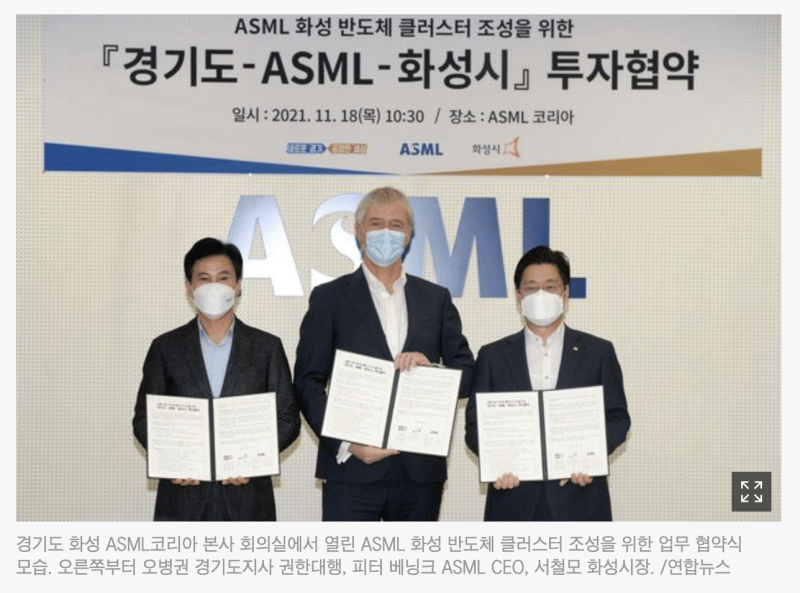
If you want one concrete anchor for the semiconductor thesis, it's ASML. The Dutch company is the world's dominant maker of extreme ultraviolet (EUV) lithography equipment — the machines without which advanced chip fabrication doesn't happen — and in 2022 it announced a roughly 240 billion KRW investment to expand its Korean operations on a 16,000 m² site inside Dongtan 2's support-facility block, near its existing headquarters by the Samsung DSR Tower. The expanded facility is planned to house around 1,500 employees, along with DUV/EUV training centers, a parts remanufacturing facility, and a semiconductor experience center.
The location detail matters for anyone thinking about this as a real estate story: the ASML site sits roughly 270 meters — walking distance — from the Dongtan D-Wave presale site near Dongtan Lake Park. That is about as direct a link between "corporate investment announcement" and "adjacent residential/commercial catchment" as you'll find in any Korean new-town market. Whatever ASML's expansion does to local employment, it does it within a few minutes' walk of specific, identifiable parcels — not somewhere abstractly "nearby."
The Smart Semiconductor City Alliance: A Policy Tailwind
The market signal isn't only coming from individual companies — it's also coming from local government coordination. In March 2022, eight Gyeonggi-do municipalities — Hwaseong, Icheon, Yongin, Suwon, Seongnam, Anseong, Pyeongtaek, and Osan — formed the "Smart Semiconductor City Alliance," a coalition explicitly organized around each city's role in hosting Samsung or SK Hynix facilities and their surrounding IT industrial complexes. The alliance has pursued recognition as a "special local government" (특별지방자치단체) under Korea's local government framework, which — if approved by the Ministry of the Interior and Safety — would let member cities form a joint council and pass shared ordinances specifically on semiconductor-industry matters, loosely modeled on how EU member states coordinate policy.
For an investor, the significance isn't the administrative structure itself — it's what the alliance formalizes: eight city governments betting their long-term economic planning on this industry, at a time when the Korea Semiconductor Industry Association projected roughly 51.6 trillion KRW in nationwide sector investment for the year, a large share of it concentrated in exactly these eight cities. That is a coordinated, multi-decade policy bet layered on top of the private capital already committed by Samsung, SK Hynix, ASML, and their suppliers.
Byeongjeom and Dongtan: Two Submarkets, One Employment Base
Byeongjeom-dong and the Dongtan new towns (Dongtan 1 and the larger Dongtan 2) are geographically distinct but functionally connected — both draw on the same semiconductor-and-supplier employment base, just from different transit angles and at different stages of build-out.
Byeongjeom sits around Byeongjeom Station on Line 1 (an express stop), historically Hwaseong's older, more established commercial and residential center, now being reshaped by the large-scale Byeongjeom Complex Town urban development project. Dongtan 2, by contrast, is one of Korea's largest second-generation new towns — by area, reportedly about 1.8 times the size of Bundang — planned around six functional zones (a community pilot district, a broad-area business complex, a culture-design valley, a tech valley, a new residential-culture town, and a waterfront complex centered on Dongtan Lake Park). It was still finishing its final presale phases as of the reporting period covered here, with infrastructure being completed in step with the last blocks of housing.
The two areas are being knit together by transit projects discussed below — most notably a planned tram line connecting Byeongjeom Station and Dongtan Station — which is part of why evaluating them as a single investment corridor, rather than two unrelated submarkets, makes sense.
Key Developments: A Historical Snapshot of the Area's Growth Trajectory
The developments below were presale announcements and local news items from the 2022 development cycle. They are included here not as current listings — pricing, availability, and construction schedules will have moved on since — but because each one illustrates a piece of how this corridor was built out, and the kind of product mix (mixed-use commercial, transit-oriented apartments, new-town housing, business-district apartments, and light-industrial space) an investor should expect to see recur here as later phases and resale inventory come to market.
Byeongjeom Complex Town (병점복합타운)
The Byeongjeom Complex Town is a roughly 375,000 m² urban development project immediately west of Byeongjeom Station — planned, per city development-project filings, for a population of about 3,200 residents across roughly 1,600 households, with a total project budget in the hundreds of billions of won, developed over a long horizon from the mid-2000s. It's designed as a mixed residential, office, and commercial district anchored by the station, including a large community sports and education facility (the "You & I Center," with a pool and ice rink) and planned connections to a future transfer center and the Byeongjeom-Dongtan tram line.
The project's commercial blocks illustrate the range of small-format investment products this kind of transit-anchored complex generates: a residential-style officetel development across three buildings; a low-rise neighborhood retail building with tall ceiling heights designed to serve both foot traffic and office tenants; and a mixed lodging-and-retail building built under Korea's Building Act rather than Housing Act — meaning this category of product typically doesn't require a housing subscription account, isn't subject to resale restrictions, and doesn't count toward an owner's housing count for tax purposes (avoiding the multi-home transfer-tax penalties that apply to registered housing). That structural distinction is worth understanding generally, since it recurs across many of the small commercial and lodging assets in this corridor and is a big part of why investors priced out of the apartment market by ownership caps have gravitated toward 지식산업센터, retail, and officetel product here instead.
Byeongjeom SK View — the Transit-Hub Apartment
Byeongjeom SK View is positioned as the area's flagship transit-oriented apartment complex, five minutes' walk from Byeongjeom Station, one minute from a Homeplus, and within a short walk of Hwaseong Malbeol Elementary School and the Hwaseong Eastern branch office, post office, and a Hanaro Mart. Its long-term positioning rests on what was, at the time, an unusually strong transit story for the area: Byeongjeom Station already carries Line 1 express service, with GTX-C and a Shinbundang Line extension both announced, and a planned tram connecting Byeongjeom and Dongtan stations, which together would make it a quadruple-transit-line hub. It also sits near Byeongjeom High School, regarded locally as Hwaseong's strongest school in the district — a factor that matters for family-buyer demand independent of the investment thesis.
As a historical illustration of how this kind of transit story showed up in pricing during the 2022 cycle: 33-pyeong units had traded as high as roughly 478 million KRW, with asking prices at the time in the 600–650 million KRW range, and jeonse (long-term deposit lease) had peaked around 450 million KRW. These figures are cited only to show how the market was pricing the transit narrative at that point in the cycle — they should not be read as current values.
Dongtan 2, Jangji-dong — the New Town's Closing Chapter
Sitting in Block A94 of Dongtan 2, this roughly 1,227-household, 18-building presale project (up to 25 floors, developed by the Gyeonggi Housing & Urban Development Corporation with a construction consortium) was marketed as effectively the last major new-build presale inside Dongtan 2 proper — meaning that, unlike earlier Dongtan 2 phases, buyers here would move into a neighborhood where schools, retail, and civic infrastructure were already substantially built out rather than still under construction.
The site is walking distance to a full school pipeline (elementary through high school) along low-traffic, speed-limited residential streets, with a neighborhood retail corner offering everyday services (clinic, dental, pharmacy, hair salon, tutoring academies) positioned so children can walk directly from school to after-school programs without crossing a main road. It sits roughly 25 minutes on foot from Dongtan Lake Park, the district's signature amenity, and near the Lakmong and Lake Como retail complexes at the lake's entrance, which house a cluster of dining, retail, and service tenants. Dongtan Station itself is a roughly 10-minute drive away (about 5 km) — bus access from stops near the site reaches Byeongjeom, Suwon, and central Seoul (City Hall, Gangnam) directly, and the site sits near Dongtan Junction for regional highway access, with the Dongtan–Icheon corridor (discussed below) opening around the same period.
Dongtan Geumgang Penterium, A59 Block — the New Residential-Culture Town
Located in Sindong, in the "New Residential-Culture Town" zone at the far eastern edge of Dongtan 2's master plan (beyond National Road 23, which is elevated at this point so it doesn't sever local pedestrian movement), this roughly 1,130-household, 20-floor presale project sits directly across from planned elementary and high school sites. Among several presale blocks competing in the same immediate area (A57-2, A58, A59), this one was positioned as the strongest of the group by local brokers, on the basis of its direct road frontage, planned neighborhood retail, partial park views, and proximity to the school sites.
Its transit story leans on regional rather than local infrastructure: the Yongin–Seoul Expressway, the Gyeongbu Expressway, Dongtan Station's SRT service, and — at various planned stages — GTX-A, a Bundang Line extension, the Uiwangbu (Indeokwon)–Dongtan double-track rail line, and the Dongtan tram. Dongtan Station itself is about 7 km away, which local marketing framed as manageable given light traffic on the connecting roads, particularly for buyers who wouldn't be commuting to Dongtan Station daily and could instead rely on the Lake Park retail corridor for day-to-day needs.
As with the SK View figures above, presale pricing discussed for this project at the time (comparisons to nearby projects trading in the low-500-million-KRW range for 33–39 pyeong units, with triple-digit oversubscription ratios) is included only as a historical illustration of demand intensity during that presale cycle, not as a current price indicator. This project — like the others in this section — was also explicitly marketed with the buyer restrictions typical of subsidized presale housing at the time (multi-year subscription-account requirements, an expected residency-obligation period, and an expected resale restriction period), underscoring that these units were structured for owner-occupiers rather than short-term flips.
Dongtan D-Wave — the Lake-Adjacent, ASML-Adjacent Presale
Dongtan D-Wave's core positioning is simple: proximity to Dongtan Lake Park (the district's most visible lifestyle amenity, prominent enough to have appeared as a filming location in Netflix's Juvenile Justice) combined with proximity to ASML's expanding Korean campus, discussed above. As covered earlier, the ASML site sits only about 270 meters from D-Wave, which local marketing at the time framed as a direct link between corporate hiring and residential/commercial demand for the project — an argument that's easy to substantiate given the concrete, named tenant sitting a short walk away, in contrast to more generic "growth area" marketing used elsewhere in the corridor.
Dongtan IT Valley — Geumgang Penterium IX Tower and the 지식산업센터 Market
Slightly apart from the residential presale story is Dongtan's light-industrial (지식산업센터) submarket, anchored by two landmarks: Hanmi Pharmaceutical's local campus (enough of a fixture that it functions as an informal wayfinding landmark for the neighborhood) and, two blocks away, Geumgang Penterium IX Tower — reportedly the largest single 지식산업센터 building in Korea. Occupancy there began in June 2021, and as of the reporting period had reached roughly 60–70% for the commercial office floors and above 95% for its officetel/dormitory component — tight enough that some tenants reportedly had to be shown vacant units near Dongtan Station instead. The building presold at roughly 6.4 million KRW per pyeong and had since carried a meaningful resale premium; a second project nearby, Hyundai Silicon Alley, was slated to complete the following year at an expected higher price point, a dynamic locally expected to lift resale values across the existing 지산 stock as it comes online.
The practical draw for tenant businesses, at the time, was cost: monthly rents in the roughly 250,000–650,000 KRW range for new-build space, well below the 1,000,000+ KRW monthly rents commonly cited for comparable Pangyo space — a gap attributed to the relatively large supply of new 지산 inventory in Dongtan at that point in the build-out cycle, which local brokers expected to compress as that supply gets absorbed. Commercial/industrial leases in Korea also commonly allow up to 10 years of renewal rights once signed, which matters for tenant businesses evaluating a multi-year commitment to the area.
Transit access into Dongtan IT Valley runs through one dominant stop: "Hanmi Pharmaceutical · Prugio" (한미약품·푸르지오), directly in front of the Dongtan IT Tower building, served by roughly 34 separate bus routes — a mix of local city buses, village buses, and intercity/express (직행) service, including routes running directly from as far as Gangnam in Seoul. Anyone evaluating a tenant business or a lease here should check the current route list directly via a transit app (e.g., KakaoBus, searching by stop name rather than route number) rather than relying on any fixed list, since routes into a growing industrial park change as ridership shifts. Door-to-door, the area is roughly 20 minutes from Gwanggyo and 30 minutes from Pangyo by road — positioning it as a lower-cost overflow location for firms priced out of those more established tech clusters.
Infrastructure & Access
The Icheon-Osan Expressway: Closing the Regional Loop
The single infrastructure event with the most direct bearing on the corridor's investment case is the opening of the Icheon-Osan Expressway (이천오산고속도로), a privately financed, 31.2 km, four-lane section of the Capital Region Second Ring Expressway that opened to traffic on March 21, 2022, at a total project cost of roughly 764.2 billion KRW. The route runs Dongtan JC → Dongtan IC → Seo-Yongin IC → Seo-Yongin JC → Pogok IC → Docheok IC → Gonjiam JC, cutting roughly 30 minutes off the previous drive time for that corridor and, just as importantly, pulling traffic off the chronically congested Giheung IC–Singal JC stretch of the Gyeongbu Expressway.
For this guide's purposes, the interchange list matters because of what each connects to: Dongtan JC ties directly into the Gyeongbu Expressway; Dongtan IC connects to National Road 23 toward Jukjeon; Seo-Yongin IC connects to National Road 42 through Cheoin-gu; Seo-Yongin JC connects onward to the Yeongdong Expressway; and Pogok IC sits immediately beside Everland. A firsthand drive of the Dongtan IC-to-Seo-Yongin JC segment, timed at roughly 9 minutes versus a previous 30–40 minutes via the Singal JC bottleneck, and the full Dongtan-to-Icheon run at roughly 40 minutes versus a previous 90-plus minutes, illustrates just how large a time-distance compression this project delivered (toll for the Icheon-to-Dongtan IC run was about 4,700 KRW at the time).
The direct real estate consequence, as flagged in coverage of the Dongtan D-Wave presale, is an expanded labor and customer catchment: the expressway connects Dongtan's residential and commercial base outward to southern Gyeonggi, Yongin, Gonjiam, and Icheon — precisely the geography where Samsung's Hwaseong operations, the incoming SK Hynix Yongin plant, and ASML's supplier network all sit. A 30-minute-plus reduction in commute and logistics time between those points and Dongtan materially widens who can realistically live in, work from, or run a supplier business out of this corridor.
Rail: GTX-C, the Shinbundang Extension, SRT, and the Dongtan Tram
Layered on top of the highway network is a set of rail projects still working through planning and construction as of this reporting: GTX-C service (targeted, per plans referenced at the time, for roughly 2023), which would cut travel time to Samseong Station in Gangnam to roughly 10 minutes and effectively extend "Gangnam commuting distance" out to this corridor; a Shinbundang Line extension; the existing Dongtan Station SRT service (already operating, connecting to national high-speed rail); a Bundang Line extension (construction start targeted around 2022 in plans referenced at the time); the Uiwangbu–Dongtan (Indeokwon–Dongtan) double-track rail line (targeted around 2026); and a Byeongjeom–Dongtan tram (targeted around 2027) that would be the key link tying the two submarkets covered in this guide into a single connected transit corridor, alongside a planned complex transfer center at Byeongjeom Station.
Investors should treat all of the above dates as planning targets rather than commitments — rail infrastructure in Korea routinely slips — but the through-line across all of them is consistent: multiple independent rail projects are all converging on the same Byeongjeom–Dongtan corridor, which is a meaningfully different risk profile than a submarket betting its whole transit thesis on a single line.
Getting to the Industrial Complex by Bus
For anyone evaluating tenant demand for 지식산업센터 or commercial space near Dongtan IT Valley specifically, the practical access story runs through bus service rather than rail: the "Hanmi Pharmaceutical · Prugio" stop outside the Dongtan IT Tower building is served by roughly 34 routes spanning local, village, and intercity/express buses, reachable from destinations as far as Gangnam without a transfer. This bus-first access pattern is worth underwriting separately from the area's rail story, since it's already operating today — unlike GTX-C, the tram, and the other rail projects above, which remain planned — and it's the access mode that actually determines day-one tenant demand for light-industrial and office space in the district right now.
Local Government & Services
Hwaseong is administratively unusual for a city its size: at roughly 693.95 km², it's larger in land area than Seoul (605.25 km²), but — unlike Seoul — it has no district (구/gu) tier of government. That means residents deal directly with either their local haengjeong bokji center (행정복지센터, the neighborhood-level civil affairs office) or Hwaseong City Hall itself, and because the city's land area is so large — the distance from Dongtan Station to the main City Hall building in Namyang-eup is roughly 40 km, comparable to the distance across Seoul from Magok Station to Gangil Station — the city runs two branch offices to keep civil services within reach of its two largest population centers.
The Dongtan branch office (동탄출장소) recently consolidated into a single new building near Dongtan Station — Green Parking Park, Osan-dong 968-5, floors 5 through 8, with attached public parking — after years of departments being scattered across multiple buildings in the area. The Eastern branch office (동부출장소), serving the Byeongjeom area, is located at Byeongjeom 3-ro 23, close to Byeongjeom Station, with general affairs, tax, transportation/construction, and civil-affairs functions distributed across three floors. Both branch offices route through a single citywide service number (1577-4200) for general inquiries.
For an investor or relocating tenant, the practical takeaway is straightforward: both submarkets covered in this guide now have a full-service local government office within a short distance — a basic but underrated piece of an area's livability case, and one that had visibly lagged the pace of residential construction here until relatively recently.
What This Means for an Investor
Pulling the threads together: Byeongjeom and Dongtan sit inside a submarket where the demand driver isn't retail sentiment or a single marquee project, but a multi-decade industrial buildout — Samsung's Hwaseong and Giheung campuses, SK Hynix's Icheon base and incoming Yongin plant, ASML's direct, walking-distance expansion into Dongtan 2, and the dense supplier network all of that pulls in — reinforced by an explicit multi-city policy alliance betting on the same industry. That demand base is being served by a rapidly maturing transit network (an already-open regional expressway, plus GTX-C, a Shinbundang extension, and a tram line all converging on the corridor) and a product mix that spans transit-oriented apartments, new-town housing, mixed commercial and lodging assets that sidestep housing-ownership restrictions, and a genuinely low-cost light-industrial (지식산업센터) submarket relative to Pangyo and Gwanggyo.
The specific presale projects referenced throughout this guide — Byeongjeom Complex Town's commercial blocks, Byeongjeom SK View, the Dongtan 2 Jangji-dong project, Dongtan Geumgang Penterium A59, and Dongtan D-Wave — should be read as illustrations of that pattern, not as current inventory; by the time you're reading this, all of them will be well past their original presale dates, with pricing, occupancy, and resale premiums that have moved on considerably. What should carry forward is the framework: identify the specific block's relationship to the semiconductor employment base, verify which transit projects are actually under construction versus still planned, and price the product type (apartment, officetel, 지산, retail) against what's currently trading, not against 2022-era figures.
If you're actively evaluating a specific block, building, or unit in this corridor, that's exactly the kind of due diligence a local agent with on-the-ground transaction history in Byeongjeom and Dongtan can walk through with you.
Frequently Asked Questions
- Why is the Byeongjeom-Dongtan area considered a semiconductor investment area?
Because Samsung Electronics' Giheung and Hwaseong campuses sit inside city limits, SK Hynix's Icheon base and planned Yongin plant are a short drive away, and ASML has committed roughly 240 billion KRW to expand its Korean operations inside Dongtan 2 -- about 270 meters from the Dongtan D-Wave presale site. Eight Gyeonggi cities, including Hwaseong, also formed a "Smart Semiconductor City Alliance" to coordinate policy around this industry.
- Are the Byeongjeom Complex Town, Dongtan D-Wave, and other developments mentioned still available for presale?
No. These were 2022-era presale announcements included here as historical context to illustrate how the corridor developed and the type of product mix it produces, not as current listings. Pricing, occupancy, and availability will have changed substantially since; check current status with a local agent before assuming any figures here still apply.
- What transit projects actually connect Byeongjeom and Dongtan?
A tram line planned to link Byeongjeom Station and Dongtan Station is the most direct connector discussed in local planning, alongside GTX-C, a Shinbundang Line extension, SRT service already running from Dongtan Station, a Bundang Line extension, and the Uiwangbu (Indeokwon)-Dongtan double-track rail line. All of these except SRT should be treated as planning targets rather than confirmed completion dates.
- How does the Icheon-Osan Expressway affect this area?
It's a 31.2 km, four-lane section of the Capital Region Second Ring Expressway that opened in March 2022, cutting drive time between Dongtan and Icheon/Gonjiam/southern Gyeonggi by roughly half and easing congestion on the Gyeongbu Expressway's Giheung-Singal stretch. It directly widens the commuting and supplier catchment for Dongtan, connecting it to the same geography where Samsung, the incoming SK Hynix Yongin plant, and ASML's supplier network operate.
- What is a jisik-saneop center (지식산업센터), and why does it come up so often in this area?
It's Korea's term for light-industrial/office buildings built for small and mid-sized businesses, similar to flex-office or light-industrial condo space. Dongtan IT Valley, anchored by Geumgang Penterium IX Tower, is one of the country's largest concentrations of this product type, historically priced well below comparable space in Pangyo, making it a common entry point for investors and tenant businesses priced out of more established tech clusters.
- Why do some commercial developments in this area avoid Korea's Housing Act restrictions?
Certain product types, such as officetel and living-lodging facilities (생활형숙박시설), are built under the Building Act rather than the Housing Act. That structure typically means no housing-subscription account is required to buy, no resale restriction applies, and the unit doesn't count toward an owner's housing count for multi-home tax purposes, which is why investors constrained by apartment ownership rules often look at this product category in Byeongjeom and Dongtan.
Get in Touch with Joy Son
Have a question about this guide? Send a quick message and we'll get back to you.